Quinoa
An Andean grain with a better amino acid profile than any cereal, although calling it a 'complete protein' falls a little short on precision. How to cook it, how far it goes and why you have to rinse it.
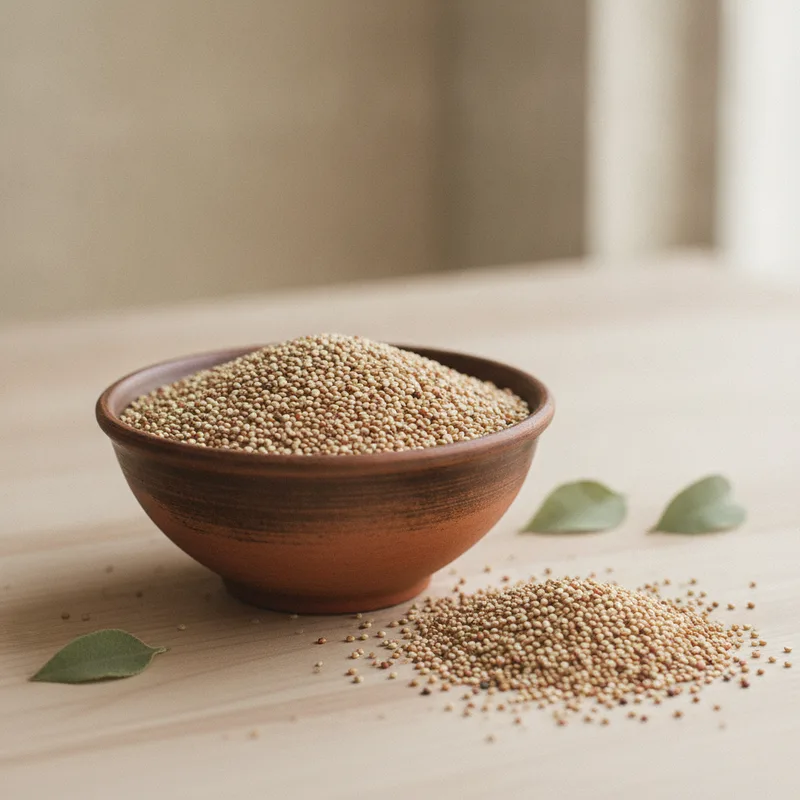
What it is good for
- Complete protein
- Gluten-free
- High in fiber
- Regulates glucose
How to use it
Cooked, as a base for bowls, salads or soups.
How much
½ cup cooked, 3-4 times/week.
Watch out
Rinse well before cooking to remove the saponins.
What it is and where it comes from
Quinoa (Chenopodium quinoa) is not a cereal. It is a pseudocereal from the spinach and chard family, and what we eat is the seed. It has been grown in the Andean Altiplano (Peru, Bolivia and northern Chile) for more than 5,000 years, at altitudes where wheat and corn simply do not grow.
Chile has its own quinoa. The one from the dry coastal farmland of the O'Higgins and Maule regions is a different variety from the Altiplano kind: a smaller grain, a milder flavor, and you can find it at street markets and bulk stores for quite a bit less than the imported one.
What the evidence says about its protein
The phrase repeated everywhere is that quinoa is a 'complete protein'. It is almost true, and the difference matters. Quinoa has all nine essential amino acids, with an amount of lysine (5.1 to 6.4%) that exceeds the FAO/WHO reference pattern and that is precisely the amino acid where cereals fall short.
But its limiting amino acid is methionine + cysteine, so the reviews more rigorously describe it as an 'almost complete' protein. Its PDCAAS, the index used to measure protein quality, ranges from 0.78 to 0.82: above practically every cereal and close to animal proteins, without quite reaching them.
The protein content of the grain varies a lot depending on the variety and the soil: analyses report between 8% and 22%, and in practice most commercial quinoa is around 14-15%.
How it is used in Chilean cooking
The ratio that works is 1 cup of quinoa to 2 of water, over low heat and covered, for 15 to 18 minutes, until the grain releases its spiral (that little white thread coming loose is the sign that it is ready). Then 5 minutes covered off the heat, and fluff it with a fork.
It replaces rice in any dish without anyone noticing: alongside a pino (ground beef and onion), in a Chilean-style salad with tomato and onion, or as the base of a bowl. It also holds up well in cazuela, where it absorbs the broth better than rice.
One cup of raw quinoa makes about three cooked, and it keeps for five days in the fridge. Cooking extra on Sunday is what gets quinoa eaten on a Tuesday.
How much, and the step almost nobody takes
Half a cup cooked, three or four times a week, is a reasonable portion to add it to the rotation without pushing other things out.
The step everyone skips: rinsing it. Quinoa comes with saponins on its husk, a bitter compound the plant makes so birds will not eat it. A 30-second rinse under running water, rubbing it with your hand in a fine sieve, removes most of it. If the water comes out foamy, there is still some left. Without that step quinoa tastes like soap and people conclude they do not like quinoa.
What to pair it with
With legumes there is no need: quinoa already brings the lysine that beans have to spare and the methionine that beans lack, so the combination complements itself. A plate of quinoa with lentils covers the amino acid profile better than either one on its own.
With some fat (avocado, olive oil, seeds), because several of its micronutrients are absorbed better that way, and because otherwise the dish turns out dry.
Frequently asked questions
Is quinoa really a complete protein?
It has all nine essential amino acids, so technically yes, but its methionine + cysteine is limiting, which is why the reviews describe it as 'almost complete'. Its PDCAAS of 0.78-0.82 puts it above cereals and below animal proteins.
Why do you have to wash quinoa before cooking it?
Because of the saponins on the husk, which are bitter and foam. Thirty seconds under running water, rubbing it in a fine sieve, is enough. If the water still comes out foamy, rinse a little longer.
Does quinoa have gluten?
No. It is not a cereal or a relative of wheat, so it works on a celiac diet. It is worth checking that the package states there was no cross-contamination during processing.
How much water does quinoa need?
Two cups of water for every cup of quinoa, 15-18 minutes over low heat, covered. It is ready when the grain releases its white spiral.
Sources
- Angeli V. et al., «Quinoa (Chenopodium quinoa Willd.): An Overview of the Potentials of the Golden Grain», Foods, 2020
- Dakhili S. et al., «Quinoa protein: Composition, structure and functional properties», Food Chemistry, 2019
- «Unveiling the nutritional spectrum: protein quality and antinutritional factors in three varieties of quinoa», 2024
This is information, not medical advice. If you have a health condition or take medication, talk to a professional before adding any supplement.
Recipes that use it
Other superfoods
Bring it into your day
In the app you snap a photo of your plate and get the calories and macros. Free, no card needed. The app is in Spanish.
Open the app