Camu camu
The fruit with the most vitamin C ever measured: between 30 and 60 times that of an orange. Exactly how much it has, why the number varies so much, and the effect on iron that almost nobody mentions.
What it is good for
- Very high in vitamin C
- Powerful antioxidant
- Strengthens immunity
- Supports vision
How to use it
Powder in juices, smoothies or as a supplement.
How much
1-2 teaspoons a day (3-6 g).
Watch out
Very tart flavor: mix it with other foods or juices.
What it is and where it comes from
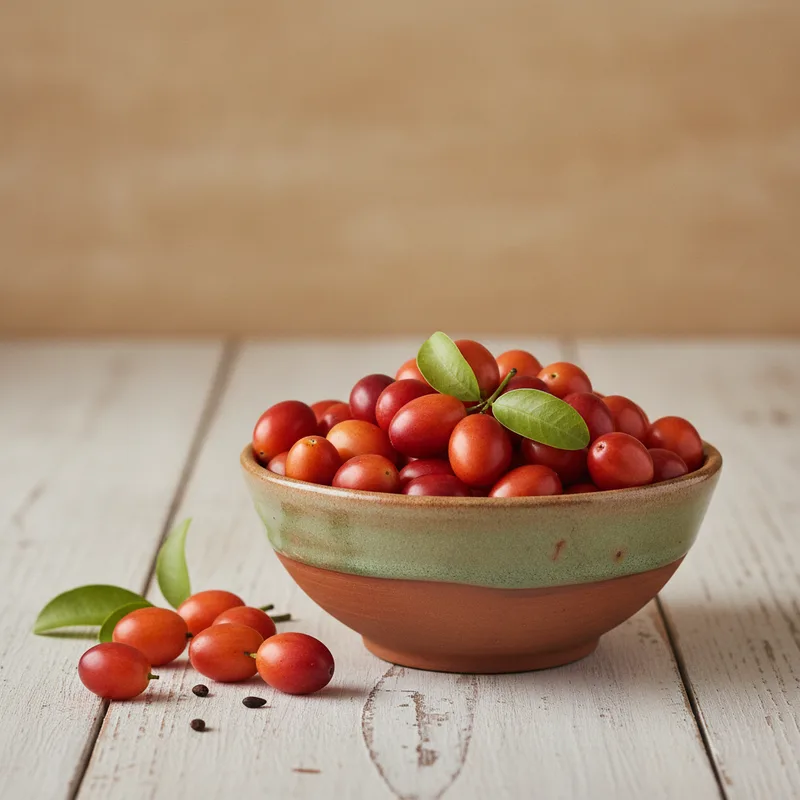
Camu camu (Myrciaria dubia) is a shrub that grows on the riverbanks of the Peruvian and Brazilian Amazon, with its feet literally underwater during the floods. It produces a grape-sized berry, red or purple, so tart that it is practically impossible to eat raw: it is consumed as frozen pulp, as juice or (most commonly outside the Amazon) as freeze-dried powder.
How much vitamin C it has, in numbers
Analyses of the fresh fruit report between 1,882 and 2,780 mg of vitamin C per 100 g of pulp, and some studies find an even wider range, from 877 to 3,133 mg. For comparison: an orange is around 50 mg per 100 g. In other words, between 30 and 60 times more.
The freeze-dried powder is far more concentrated, around 20 g per 100 g of product, because the water has been removed. That is why doses are measured in teaspoons and not in cups.
The number varies so much between studies because it depends on how ripe the fruit is (the vitamin C is mostly in the skin and drops as it ripens), on the soil and on the analysis method. Any brand that gives you an exact figure down to the milligram is rounding off a reality that is a range.
What vitamin C really does
Vitamin C is an essential nutrient: the human body does not make it and needs it to synthesize collagen, for the metabolism of several neurotransmitters and for the normal functioning of the immune system. That is established and not up for debate.
What is worth understanding is that 'more' is not 'better'. The daily recommendation for an adult is around 75-90 mg, and above about 200 mg a day absorption is saturated: whatever is left over is eliminated in the urine. One teaspoon of camu camu already goes well beyond that ceiling.
The honest argument for camu camu is not that it provides 30 times the vitamin C you need (that does you no good at all), it is that it comes with anthocyanins and other polyphenols from the whole fruit, which an ascorbic acid pill does not have.
The iron detail almost nobody mentions
Vitamin C improves the absorption of non-heme iron (the kind in legumes, spinach and grains), and that is why people recommend drinking orange juice with lentils. With camu camu the story is different.
A study that measured iron bioavailability in a Caco-2 cell model found that camu camu, despite its very high vitamin C content, had a negative effect on iron absorption. The likely explanation is its tannins and polyphenols, which bind to iron and block it, outweighing the help from vitamin C.
In practice: if what you want is to raise your iron, camu camu is not the tool. A lemon squeezed over your lentils does that job better.
How to use it and how much
Half to one teaspoon of powder a day (2-5 g) is the usual amount. It is intensely tart, so dissolve it in a fruit smoothie, in juice or in water with something sweet; on its own in water it is hard to drink.
Do not put it in hot preparations: vitamin C breaks down with heat. It goes in at the end, on top of the smoothie once it is served.
Its acidity is strong and can bother tooth enamel if you take it straight and often; a straw or mixing it into a preparation solves that.
Where to find it in Chile
It is imported, so its price per kilo is high and it is sold in small packages. You will find it in health food stores and in shops selling Peruvian products. Check that the label says freeze-dried or powdered camu camu with no additives: there are blends with maltodextrin or with added synthetic ascorbic acid, which is exactly the opposite of why you would buy camu camu.
Frequently asked questions
How much vitamin C does camu camu have?
The fresh fruit is reported at between 1,882 and 2,780 mg per 100 g of pulp, with published ranges of up to 3,133 mg. An orange has around 50 mg per 100 g, so we are talking about 30 to 60 times more.
Is it useful to take that much vitamin C?
The daily recommendation is 75-90 mg, and above about 200 mg absorption is saturated: the rest is eliminated. The value of camu camu is not in the amount of vitamin C but in the fact that it comes with the anthocyanins and polyphenols of the whole fruit.
Does camu camu help you absorb iron?
The opposite of what you would expect: a study in a Caco-2 cell model found a negative effect on iron bioavailability, probably because of its tannins and polyphenols. For iron, a squeeze of lemon on your lentils is better.
Can you cook camu camu?
It is not a good idea: vitamin C breaks down with heat. Add it at the end, on top of the finished preparation.
Sources
- Fracassetti D. et al., «Nutritional composition and vitamin C stability in stored camu-camu (Myrciaria dubia) pulp», Archivos Latinoamericanos de Nutrición
- «Negative Effect of Camu-Camu (Myrciaria dubia) Despite High Vitamin C Content on Iron Bioavailability, Using a Caco-2 Cell Model», Polish Journal of Food and Nutrition Sciences
- «Vitamin C content in fruits of camu camu (Myrciaria dubia) in four states of maturation», INIA Loreto, Peru
This is information, not medical advice. If you have a health condition or take medication, talk to a professional before adding any supplement.
Other superfoods
Bring it into your day
In the app you snap a photo of your plate and get the calories and macros. Free, no card needed. The app is in Spanish.
Open the app