Cañihua
Quinoa's little cousin, with the highest lysine of the Andean grains and flavonoids of 36 to 144 mg/100 g. And it needs no washing: it has no saponins.
What it is good for
- Complete protein
- Rich in calcium and iron
- Low glycemic index
- Ancestral Andean
How to use it
Cooked like rice, as flour in breads, or in soups.
How much
½ cup cooked, 2-3 times/week.
Watch out
Cooking time: 15-20 minutes.
What it is and where it comes from
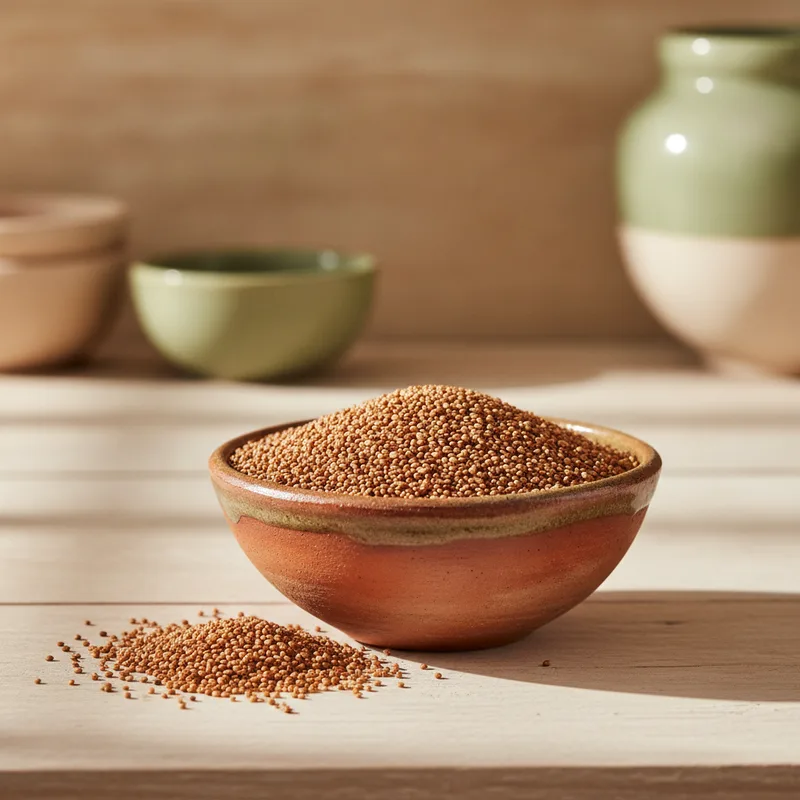
Cañihua (Chenopodium pallidicaule), also spelled kañiwa or kañihua, is a first cousin of quinoa: same genus, same region, a much smaller seed and dark brown in color. It grows above 3,800 meters around Lake Titicaca, in conditions where not even quinoa does well: it withstands frost, drought and salty soils.
It is the least known of the Andean grains and probably the most underrated. Outside Peru and Bolivia it is hardly sold at all, and its most common form is toasted flour, which in the Altiplano is called cañihuaco.
What the evidence says
In protein it is on par with the rest: the Andean grains range from 15.0% to 16.3% on a dry basis, compared with 7% for rice and 9% for corn. But there is one figure where cañihua wins.
The comparative analysis of Andean grains notes that they all have a good amino acid profile, and that kañiwa in particular has a very high lysine content (the highest in the group). Lysine is precisely the limiting amino acid in cereals, so a plant source rich in lysine is valuable in a meat-free diet.
With flavonoids the result is just as striking: quinoa and kañiwa have exceptionally high contents, from 36.2 to 144.3 mg per 100 g, while no quantifiable amounts were detected in kiwicha. They are two grains that look alike and do not provide the same thing.
The practical advantage: no washing
Quinoa comes with bitter saponins on its husk and has to be rinsed. Cañihua does not: it has none, or a negligible amount. You cook it straight away.
That may sound minor, but it is the difference between cooking an Andean grain on a Tuesday at eight in the evening or not cooking it at all. One step less.
How to use it in the kitchen
The grain is cooked at 1 part to 2 of water, for about 15 minutes. It turns out looser than kiwicha and its flavor is more toasted, almost nutty, stronger than quinoa's.
Cañihuaco (the toasted flour) is the traditional form and the most versatile: one or two tablespoons in hot milk, in a smoothie, or stirred into yogurt. In the Altiplano it is drunk like this as a working breakfast, and it makes sense: it provides protein and carries you through the morning.
It also works as a partial flour replacement in cakes and pancakes, up to a third of the total. More than that and the dough does not bind, because it has no gluten.
How much
Half a cup cooked or two tablespoons of cañihuaco, three or four times a week. There are no known contraindications: it is a grain, and you eat it like a grain.
Where to find it in Chile
It is the hardest of the four to find. It is available almost only in shops selling Peruvian and Bolivian products, and in a few large health food stores; in bulk at La Vega market if you are lucky. If you see it as 'cañihuaco', that is the toasted and ground version, which is the one that goes furthest day to day.
Frequently asked questions
What is the difference between cañihua and quinoa?
Cañihua belongs to the same genus, with a smaller, darker grain, a more toasted flavor and one big practical advantage: it has no saponins, so you do not need to wash it. Its lysine content is the highest of the Andean grains.
Do you need to wash cañihua before cooking it?
No. Unlike quinoa, it has no bitter saponins on its husk. You cook it straight away.
What is cañihuaco?
Toasted cañihua flour, which is the traditional way it is eaten in the Altiplano. One or two tablespoons in hot milk, in a smoothie or stirred into yogurt.
Does cañihua have gluten?
No. It is a pseudocereal, related to quinoa and spinach, not to wheat. For the same reason its flour does not bind on its own in baking: it replaces up to a third of the wheat flour, no more.
Sources
- «Potential of Andean Grains as Substitutes for Animal Proteins in Vegetarian and Vegan Diets: A Nutritional and Functional Analysis», Foods, 2025
- Repo-Carrasco-Valencia R. et al., «Flavonoids and other phenolic compounds in Andean indigenous grains: quinoa, kañiwa and kiwicha»
- «Nutritional Value and Bioactive Compounds in Andean Ancient Grains», Proceedings, 2020
This is information, not medical advice. If you have a health condition or take medication, talk to a professional before adding any supplement.
Other superfoods
Bring it into your day
In the app you snap a photo of your plate and get the calories and macros. Free, no card needed. The app is in Spanish.
Open the app