Sacha inchi
The Amazonian seed whose oil is 46-51% omega-3 ALA, the highest percentage of any known plant oil. Why that does not make it a cooking oil and how it is really used.
What it is good for
- Plant omega-3 (48%)
- Complete protein
- Anti-inflammatory
- Heart health
How to use it
Roasted as a snack, as oil on salads, or as flour in smoothies.
How much
1-2 tablespoons a day (15-30 g).
Watch out
The oil is heat-sensitive: do not cook it at high temperatures.
What it is and where it comes from
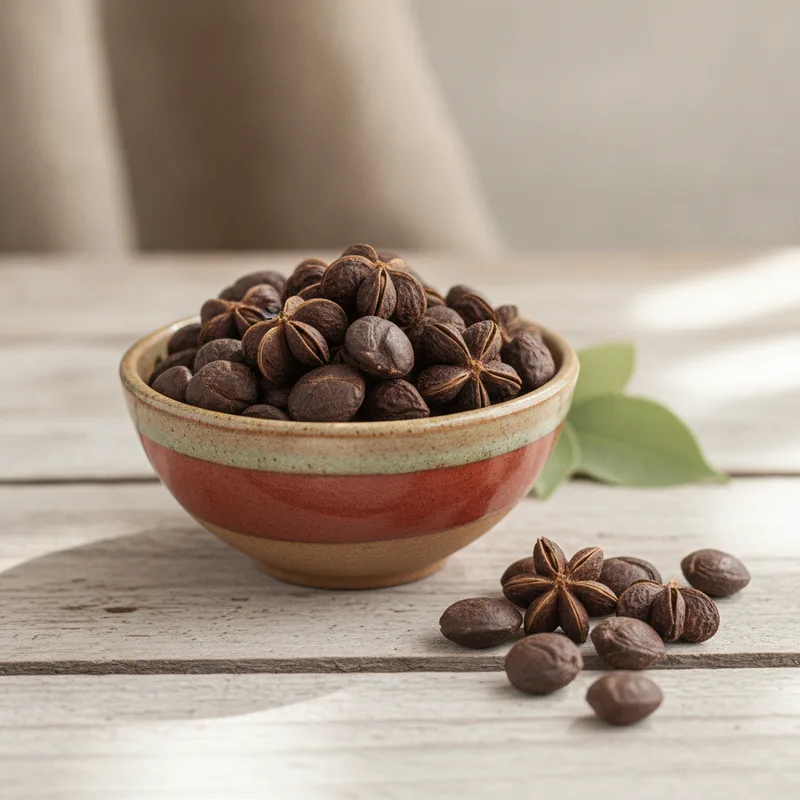
Sacha inchi (Plukenetia volubilis) is an Amazonian vine that bears a star-shaped fruit with four to seven points, and inside each point, a seed. It is grown in the highland jungle of Peru, Ecuador and Colombia, and in Quechua its name means something like 'wild peanut' (although it is not a peanut and has nothing to do with one).
It is eaten in three ways: the roasted seed, which tastes a bit like a large, mild peanut; the cold-pressed oil; and the flour left after the oil is extracted, which is almost pure protein.
The number that makes it unique
Here the figure really is as good as it sounds. Analyses of sacha inchi oil from Ecuador and Peru find an alpha-linolenic acid content (the plant omega-3) of 51.5% and 46.6% respectively. It is the highest percentage measured in any plant oil.
The second fatty acid is linoleic acid (omega-6), at 32.5% to 36.5%. Together they make up about 82% of the oil, and total polyunsaturated fat reaches 82.6-86.7%. Only 6.8-9.1% is saturated fat.
To put the number in context: chia, the popular benchmark for plant omega-3, has less ALA per gram of oil than sacha inchi. And as with chia, that omega-3 is ALA, not the EPA and DHA from fish, and the body converts one into the other with low efficiency.
Why it is not a cooking oil
This is the part the label does not tell you, and it is the most important in practice. The very thing that makes sacha inchi special (having more than 82% polyunsaturated fat) is what makes it terrible for heat: the more double bonds a fat has, the faster it oxidizes.
Frying with sacha inchi oil destroys what you went out to buy and creates oxidation compounds along the way. It goes on raw: over salad, on top of the dish once served, in a pesto, or straight from a teaspoon.
For the same reason, once opened it is kept in the fridge in its dark bottle. If it smells like old paint or rancid, it has oxidized: throw it out, do not use it anyway.
How to use it and how much
One teaspoon to one tablespoon of oil a day (5-15 ml) is the usual amount. The roasted seed works as a snack or on top of a salad, and there the reasonable portion is a small handful, about 20-30 g.
Sacha inchi flour is high in protein and works in smoothies, although the flavor is earthier than a commercial protein powder.
The oil has a vegetal flavor, somewhere between artichoke and walnut, that many people find odd at first. Mixed with lemon and salt in a salad, it disappears.
Watch out
The seed is never eaten raw: it contains alkaloids and saponins that are destroyed by roasting. All the ones on sale come roasted, but if you ever get hold of the fresh fruit, do not try the seeds raw.
Like any oil it is calorie-dense (about 120 kcal per tablespoon), so it goes into the dish as part of it, not on top of what was already there.
Where to find it in Chile
It is imported and the price shows it: in health food stores, shops selling Peruvian products and some large supermarkets. Look for 'cold-pressed' on the label and a dark bottle; oil in a clear bottle on a brightly lit shelf has already lost some of what you are paying for.
Frequently asked questions
How much omega-3 does sacha inchi have?
Its oil is 46.6% to 51.5% alpha-linolenic acid (ALA) according to analyses of Peruvian and Ecuadorian seeds: the highest percentage measured in a plant oil. Together with linoleic acid they make up about 82% of the oil.
Can you fry with sacha inchi oil?
No. More than 82% of its fats are polyunsaturated, which is exactly what oxidizes quickly with heat. Frying with it destroys what you went out to buy. It goes on raw, on top of the dish once served.
Does sacha inchi replace fish?
No. Its omega-3 is ALA, and the one linked to cardiovascular health in the large studies is EPA and DHA, from oily fish. The body converts ALA into EPA and DHA with low efficiency.
Can you eat sacha inchi seeds raw?
No. Raw, they contain alkaloids and saponins that are destroyed by roasting. All the ones on sale come roasted.
Sources
- Chirinos R. et al., «Sacha inchi (Plukenetia volubilis): A seed source of polyunsaturated fatty acids, tocopherols, phytosterols, phenolic compounds and antioxidant capacity», Food Chemistry, 2013
- «Lipid composition of the Amazonian Mountain Sacha Inchis», Scientific Reports, 2022
- Follegatti-Romero L.A. et al., «Chemical composition of Sacha Inchi (Plukenetia volubilis L.) seeds and characteristics of their lipid fraction», Grasas y Aceites
This is information, not medical advice. If you have a health condition or take medication, talk to a professional before adding any supplement.
Recipes that use it
Other superfoods
Bring it into your day
In the app you snap a photo of your plate and get the calories and macros. Free, no card needed. The app is in Spanish.
Open the app