Moringa
It is called 'the miracle tree' and the 2025 meta-analyses say otherwise. What the human trials found, how certain that evidence is, and what moringa leaf really is good for.
What it is good for
- A wealth of nutrients
- Complete protein
- Anti-inflammatory
- Gentle detox
How to use it
Powder in smoothies, teas, soups or water.
How much
1 teaspoon a day (5 g).
Watch out
Strong grassy flavor: mix it with flavorful foods.
What it is and where it comes from
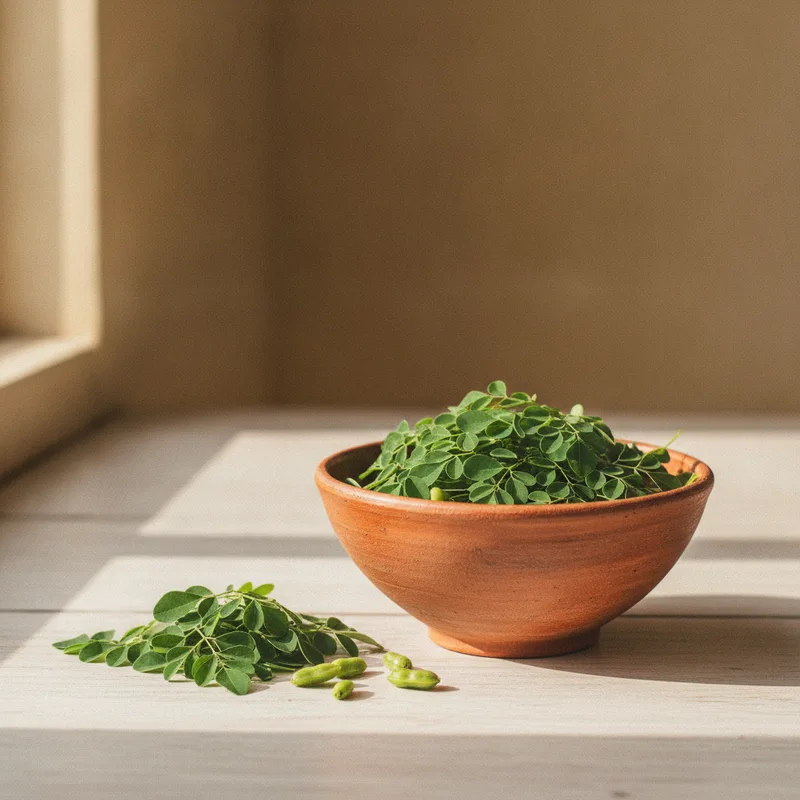
Moringa (Moringa oleifera) is a tree native to northern India that today is grown across almost the entire tropical belt. Nearly all of it is eaten (pods, seeds, flowers), but what is sold as a superfood is the leaf, dried and ground into a green powder.
Its fame comes from two different places. One is legitimate: in areas with food insecurity, moringa leaf is a micronutrient-dense food that grows fast in poor soil, and there its value is real and documented. The other, not so much: the marketing that carried it to the West as a cure for everything, diabetes included.
What the evidence in humans says
Here the summary is uncomfortable and it has to be given in full. A 2025 meta-analysis on cardiometabolic outcomes, with a search up to April of that year and a GRADE assessment of certainty, concluded that despite encouraging results in preclinical studies, human trials give mixed results: some report benefits for glycemic control and lipids, others find no significant effect.
On blood sugar: a meta-analysis of five trials in people with type 2 diabetes or prediabetes found no significant effects on glycated hemoglobin or fasting glucose.
On lipids: no significant pooled effects were seen on any lipid outcome, and heterogeneity between studies remained high. In people with prediabetes, 2.4 g a day of leaf powder produced favorable within-group changes in glycemic markers, but no significant changes in triglycerides, total cholesterol, LDL or HDL.
And the sentence that puts all of the above in order: every outcome was rated low to very low certainty, because of methodological limitations and heterogeneity between studies. Clinical trials are scarce and vary in design.
Honest conclusion: moringa has not been shown to treat anything. If you have diabetes, moringa does not replace your medication, and that sentence is not a legal disclaimer, it is what the studies found.
So what is it good for?
For what it is: a very nutrient-dense green leaf. It provides calcium, iron, potassium, vitamin A and plant protein in high amounts per gram, and a spoonful holds quite a bit more of that than a lettuce leaf.
Seeing it that way (as a concentrated vegetable rather than a supplement) is more useful and also more sustainable: nobody stops taking moringa disappointed because it did not lower their blood sugar.
How to use it and how much
The studies used between 2 and 6 grams a day of leaf powder, that is, one to two teaspoons. It tastes like green tea with an arugula-like bitter undertone, and that bitterness is what makes people give up on it.
It works best where the bitterness has company: in a green smoothie with banana and ginger, stirred into a soup once served, or mixed into a salad dressing. In plain water it is hard going.
Like camu camu, it goes in at the end: prolonged heat breaks down some of its vitamins.
When not to
The root and its bark contain compounds that have been linked to uterine contractions, so it is avoided during pregnancy (and, as a precaution, so is the leaf powder).
If you take medication for diabetes or blood pressure, talk to your doctor first: although the group effect was not significant, there are individual studies with glycemic changes, and adding it to a glucose-lowering drug without supervision is not a good idea.
Where to find it in Chile
You will find it in health food stores and in the health food section of large supermarkets, almost always imported from India or Peru. A fresh moringa leaf powder is a deep green; if it is brown or a dull green, it has been sitting for a long time or was processed with heat, and much of what you went looking for is gone.
Frequently asked questions
Does moringa lower blood sugar?
A meta-analysis of five trials in people with type 2 diabetes or prediabetes found no significant effects on glycated hemoglobin or fasting glucose. The certainty of the evidence was rated low to very low. It does not replace any treatment.
How much moringa powder do you take a day?
The studies used between 2 and 6 grams a day of leaf powder, that is, one to two teaspoons.
Does moringa lower cholesterol?
The meta-analyses found no significant pooled effects on any lipid outcome (not triglycerides, not total cholesterol, not LDL, not HDL), and heterogeneity between studies was high.
Can you take moringa during pregnancy?
It is not recommended. The root and bark contain compounds linked to uterine contractions, and as a precaution the recommendation extends to leaf powder.
Sources
- «Effects of Moringa oleifera Lam. Supplementation on Cardiometabolic Outcomes: A Meta-Analysis of Randomized Controlled Trials with GRADE Assessment», Nutrients, 2025
- Vargas-Sánchez K. et al., «Potential of Moringa oleifera to Improve Glucose Control for the Prevention of Diabetes: A Systematic Review of Animal and Human Studies», Nutrients, 2020
- «Moringa oleifera Leaf Supplementation as a Glycemic Control Strategy in Subjects with Prediabetes», Nutrients, 2022
This is information, not medical advice. If you have a health condition or take medication, talk to a professional before adding any supplement.
Other superfoods
Bring it into your day
In the app you snap a photo of your plate and get the calories and macros. Free, no card needed. The app is in Spanish.
Open the app