Maca
The Andean root sold as an energizer and aphrodisiac. What the systematic reviews really found, how long it takes, and why it is best not to take it at night.
What it is good for
- Energy and stamina
- Hormonal balance
- Anti-inflammatory
- Fertility
How to use it
Powder in smoothies, coffee, yogurt or cookies.
How much
1-2 teaspoons a day (3-6 g).
Watch out
Start with low doses so your body can adapt.
What it is and where it comes from
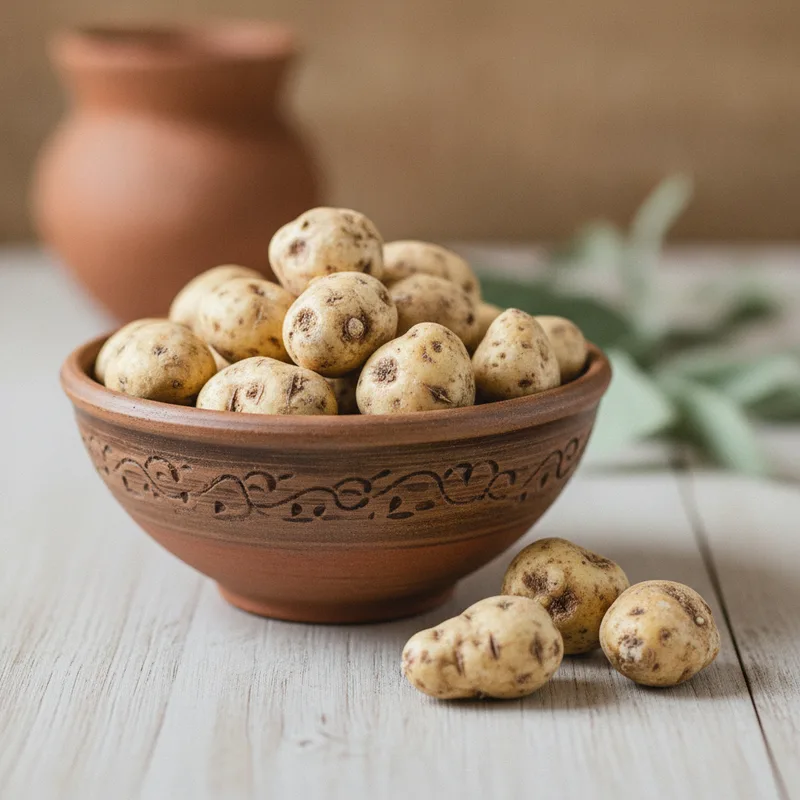
Maca (Lepidium meyenii) is a root from the radish and broccoli family that grows above 4,000 meters, on the Junín plateau in Peru, in one of the harshest farming climates in the world. It is eaten dried and ground into flour, or gelatinized (cooked and then ground), which is the form that is easiest on the stomach.
There is yellow, red and black maca. They are sold with different properties, and that distinction still has no serious clinical backing: most studies used yellow maca or did not specify the color.
What the evidence says, without embellishment
This is where most superfood pages exaggerate, so it is worth being precise. The benchmark systematic review searched 17 databases for every randomized clinical trial of maca against placebo. It found four.
Of those four: two showed a significant positive effect (one on sexual function in postmenopausal women, the other on sexual desire in healthy adult men); one in cyclists showed no effect at all; and one in men with erectile dysfunction did show an effect measured with the IIEF-5 index.
The authors' conclusion is the one worth repeating: the evidence that maca helps sexual function is limited, and the number of trials, the sample sizes and the methodological quality are too scarce to draw firm conclusions. A later review focused on erectile dysfunction found only two trials that met the criteria.
Put simply: there is a signal, there is no proof. Maca is not hot air, but it is not what the label promises either.
About energy and hormones
Maca is sold as an energizer. It has no caffeine or any central nervous system stimulant, so what people describe is not a jolt of energy but something closer to feeling less exhausted, and it appears after weeks, not hours.
It is called an 'adaptogen', a word that sounds like a mechanism and is not one: there is no agreed physiological definition. And although it is associated with hormonal regulation, a study in healthy men found no changes in serum levels of reproductive hormones.
How to use it and how much
The trials used between 1.5 and 3 grams a day, which is roughly one heaping teaspoon of powder. Starting with half and working up is sensible: the digestive effect of raw maca surprises a lot of people.
It dissolves poorly in cold water and tastes like toasted earth. It works much better in a smoothie with banana (which masks the flavor and adds sweetness) or in hot oatmeal. The gelatinized version is the one to choose if your stomach complains.
In the morning, not at night: although it is not a classic stimulant, many people who try it report trouble sleeping if they take it late.
When not to
Maca is a cruciferous plant and contains glucosinolates, so if you have hypothyroidism or a thyroid problem it is best to check first: in large amounts those compounds can interfere with iodine uptake.
There is not enough safety data on pregnancy and breastfeeding. And if you are on hormone treatment, that conversation is with your doctor, not with a web page.
Where to find it in Chile
You will find it in health food stores, in the health food section of large supermarkets and in bulk at La Vega market. Imported Peruvian maca usually comes gelatinized; what is sold in bulk is almost always raw. Check that the package says only 'maca' (some of what is sold comes mixed with maltodextrin as filler).
Frequently asked questions
What is maca good for, according to the studies?
The benchmark systematic review found four randomized trials: two with a positive effect on sexual function and desire, one with no effect and one positive in erectile dysfunction. The authors themselves conclude that the evidence is limited and that the studies are too few and too small to claim more.
How much maca should you take a day?
The trials used between 1.5 and 3 grams a day, one heaping teaspoon of powder. It is a good idea to start with half to see how your stomach handles it.
Does maca give you energy like coffee?
No. It contains no caffeine or stimulants. What people report is not a jolt of energy but a lower sense of exhaustion, and it appears after weeks of continuous use.
Who should not take maca?
People with thyroid problems should check first, because maca is a cruciferous plant and contains glucosinolates. There is also not enough safety data on pregnancy and breastfeeding.
Sources
- Shin B.C. et al., «Maca (L. meyenii) for improving sexual function: a systematic review», BMC Complementary and Alternative Medicine, 2010
- «Maca (L. meyenii) for erectile dysfunction: a systematic review and meta-analysis», Journal of Men's Health, 2023
- Gonzales G.F. et al., «Effect of Lepidium meyenii (Maca) on serum reproductive hormone levels in adult healthy men» (Cochrane CENTRAL record)
This is information, not medical advice. If you have a health condition or take medication, talk to a professional before adding any supplement.
Recipes that use it
Other superfoods
Bring it into your day
In the app you snap a photo of your plate and get the calories and macros. Free, no card needed. The app is in Spanish.
Open the app