Golden berry (aguaymanto)
Also called uchuva or physalis: 32 mg of vitamin C and 5.16 g of fiber per 100 g. What the withanolides behind its fame are and why the evidence is still in the test tube.
What it is good for
- Rich in vitamin C
- Antioxidant
- Supports digestion
- Low glycemic index
How to use it
Fresh as a snack, dried, or in juices.
How much
A handful a day (30-50 g fresh).
Watch out
Look for ripe fruit (yellow).
What it is and where it comes from
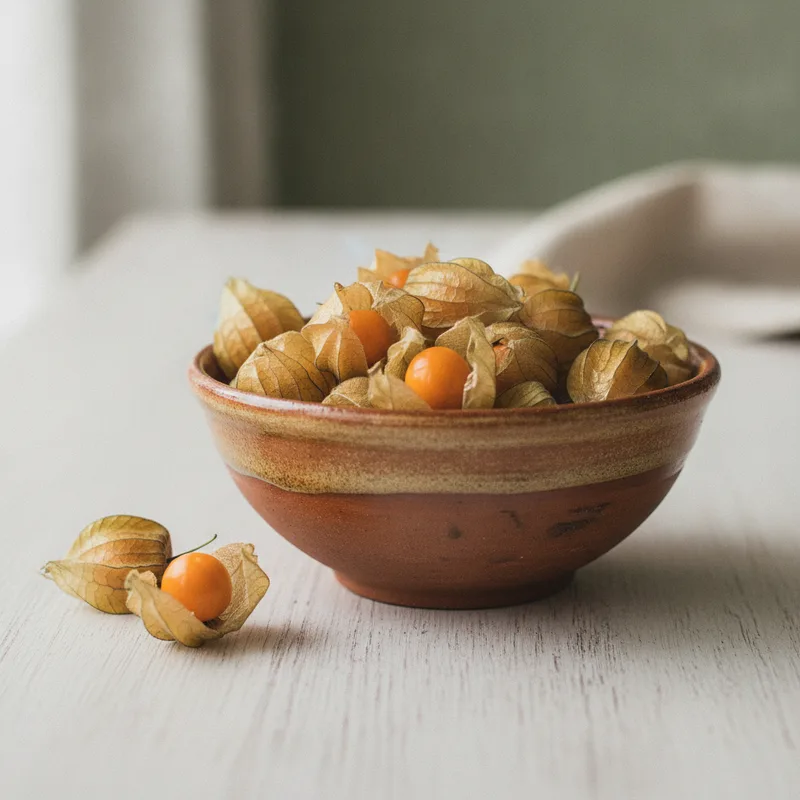
Golden berry, or aguaymanto (Physalis peruviana), is an orange berry the size of a cherry, wrapped in a papery husk that looks like a little lantern. In Chile it is better known as physalis or uchuva, and in the English-speaking world as goldenberry. It is related to the tomato and the chili pepper (the nightshade family), not to berries.
It grows in the Andean valleys of Peru, Ecuador and Colombia, and it is also grown in Chile. It is eaten fresh, dried (which is how you find it most often here) or as jam.
What it has, in numbers
One hundred grams of fresh fruit provide 32 mg of ascorbic acid (vitamin C), 5.16 g of dietary fiber, 2.34 mg of tocopherols (vitamin E), 253 mg of potassium, 45 mg of phosphorus and 20 mg of magnesium, with only 0.49 g of fat.
The 5.16 g of fiber per 100 g is the most solid figure on the list and the most underrated: it is more fiber than most fresh fruits, and it comes with the rest of the whole fruit.
Be careful with the dried version, which is the one that sells most: removing the water concentrates everything, sugars included, and many brands also add sugar to offset the tartness. It is a dried fruit, not a free-for-all snack.
The withanolides, and how far the evidence goes
Golden berry's fame comes from its withanolides and physalins, compounds typical of the Physalis genus. HPLC-DAD-ESI/MS analysis of the fruit extract identified five physalin derivatives and one withanolide.
These compounds have shown a wide range of pharmacological activities in vitro: immunomodulatory, antioxidant, antibacterial and antitumor. The fruit extract showed significant antiproliferative activity against human colorectal adenocarcinoma cells (Caco-2) and lung carcinoma cells (NCI-H460), and the husk extracts showed high antioxidant activity and the ability to inhibit the formation of advanced glycation end products.
Now the sentence you have to read in full, and the authors themselves write it: it is not clear whether these compounds are bioaccessible and bioavailable in humans. In other words: they work on cells in a dish, and no one has yet shown that they reach your body in useful amounts when you eat the fruit.
Research in humans exists but is in its early days: there is a study of the plasma metabolomic profile after acute and medium-term intervention with the fruit, which points to signaling pathways linked to insulin. It is a lead, not a clinical result.
How to use it
Fresh is the best way: remove the husk, rinse it (it has a natural sticky film) and eat it whole. The flavor is sweet and sour, somewhere between a cherry tomato and passion fruit, and it surprises anyone expecting something sweet.
It works remarkably well in green salads: cut in half, it adds acidity where you would normally use lemon. Also in sauces for meat or fish, taking advantage of the fact that it is a nightshade and behaves like a tart tomato.
Dried, as dried fruit in yogurt or granola, in a dried-fruit portion: a small handful.
Watch out
The green, unripe fruit is not eaten: as with tomatoes and potatoes, nightshades concentrate solanine in unripe fruit. Golden berry is ready when the husk is dry and paper-colored, and the fruit inside is a deep orange.
If you are sensitive to nightshades (tomato, eggplant, chili pepper), golden berry belongs to the same family.
Where to find it in Chile
Fresh, you find it at street markets and in large supermarkets in season, sometimes under the name physalis and at gourmet-fruit prices. Dried, in health food stores and in bulk. If you buy it dried, check the ingredient list: if it says 'sugar' after the fruit, you are buying candy.
Frequently asked questions
What is aguaymanto and what is it called in Chile?
It is Physalis peruviana, the orange berry wrapped in a papery husk. In Chile it is known as physalis or uchuva; in English, goldenberry. It is related to the tomato, not to berries.
How much vitamin C does golden berry have?
32 mg per 100 g of fresh fruit, plus 5.16 g of fiber, 2.34 mg of tocopherols, 253 mg of potassium and 20 mg of magnesium.
Does golden berry work against cancer?
There is no evidence to support it in people. Its extracts showed antiproliferative activity on cell lines in the lab, but the authors themselves point out that it is not clear whether those compounds are bioavailable in humans. It is ongoing research, not a clinical result.
Can you eat green golden berries?
No. Like all nightshades, the unripe fruit concentrates solanine. It is ready when the husk is dry and paper-colored and the fruit inside is a deep orange.
Sources
- «Nutrients, Phytochemicals, and In Vitro Biological Activities of Goldenberry (Physalis peruviana L.) Fruit and Calyx», Plants, 2025
- «Plasma Metabolome Profiling after Acute and Medium-Term Intervention with Golden Berry Fruit (Physalis peruviana L.)», Nutrients, 2021
- «Goldenberry (Physalis peruviana L.): phytochemicals and applications in human health», Revista Mexicana de Ciencias Agrícolas
This is information, not medical advice. If you have a health condition or take medication, talk to a professional before adding any supplement.
Other superfoods
Bring it into your day
In the app you snap a photo of your plate and get the calories and macros. Free, no card needed. The app is in Spanish.
Open the app